Calcium Chloride Food Grade Supplier, Exporter & Global Wholesaler
PAU Chemicals is an India-based global supplier and exporter of Food Grade Calcium Chloride (E509) in anhydrous and dihydrate form, for dairy, brewing, canning and beverage manufacturers worldwide.
Calcium Chloride is a highly soluble calcium salt used across food manufacturing as a firming agent, coagulant and mineral source. It is one of the few additives that improves texture and process yield at the same time.
In cheesemaking it restores the calcium balance lost in pasteurisation, giving a firmer curd and better yield. In canning and pickling it keeps vegetables crisp, and in brewing it corrects water hardness for consistent mash performance.
PAU Chemicals supplies food grade meeting FCC and E509 requirements, in anhydrous granules and dihydrate flakes, so you can match the form to your dosing and storage setup.
Pro Tip: Calcium chloride is strongly hygroscopic and dissolution is exothermic. Keep bags sealed against humidity, and add it to water slowly with stirring rather than all at once.Technical Specifications
Product Characteristics | Product Details |
Product Name | Calcium Chloride |
Chemical Formula | CaCl₂ / CaCl₂·2H₂O |
CAS Number | 10043-52-4 (anhydrous) |
HS Code | 2827 20 00 |
E / INS Number | E509 |
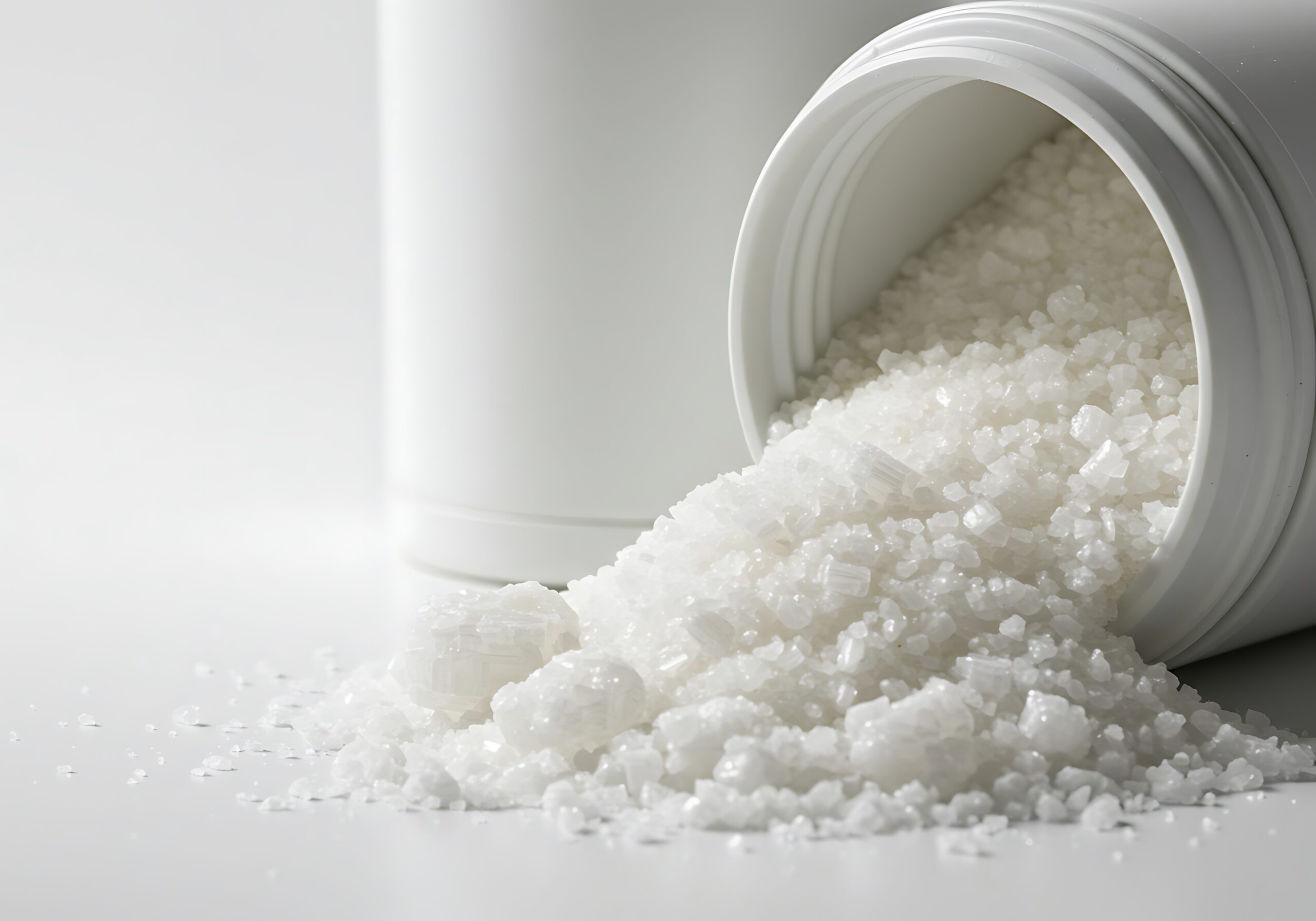
Appearance | White granules, prills or flakes |
Odour | Odourless |
Assay (Anhydrous) | 94.0% min |
Assay (Dihydrate) | 74.0 – 78.0% |
Alkalinity (as Ca(OH)₂) | 0.25% max |
Magnesium & Alkali Salts | 5.0% max |
Fluoride | 0.004% max |
Heavy Metals (as Pb) | 10 ppm max |
Arsenic (As) | 3 ppm max |
pH (5% solution) | 4.5 – 9.5 |
Solubility in Water | Freely soluble (exothermic) |
Storage | Sealed, dry, moisture-protected |
Reference Standard | FCC / E509 |
Available Grades
Anhydrous granules / prills
Export Details
Minimum Order Quantity: 1 FCL
Country of Origin: India
Mode of Transportation: By Sea
Loading Ports: Hazira (Surat, Gujarat) & Nhava Sheva / JNPT (Navi Mumbai)
Shipping: FCL
Incoterms: EXW, FOB, C&F (CFR) & CIF
Payment Terms: TT / Bank Transfer & LC at Sight
Delivery Time: 3 to 4 weeks
Logistics Packaging: 25 kg HDPE/PP bags with moisture-barrier line
Dangerous Goods: Not classified as dangerous goods for transport
Documentation: Invoice, Packing List, Bill of Lading, COA, MSDS & Certificate of Origin
Certifications





Industrial & Technical Applications
Pharmaceutical and nutraceutical calcium source
Pet food and animal nutrition
Water treatment and hardness correction
Food & Beverage Applications
Cheese making — curd firmness and yield recovery after pasteurisation
Tofu and soy product coagulation
Firming agent in canned vegetables, fruit and pickles
Brewing water treatment and mash pH correction
Electrolyte in sports and functional drinks
Calcium fortification of beverages and dairy
Texture control in low-sodium and reduced-salt products
Why Choose PAU Chemicals
Genuine Direct Supply — straight to the importer with no hidden intermediaries
Ethical Sourcing — ensuring 100% transparent and compliant procurement
Stable, Consistent Quality — for uninterrupted production and reliable 94% minimum assay
Competitive Pricing — offering strong commercial value for bulk FCL buyers
Flawless Documentation — handling all trade paperwork for smooth port clearance
Preferential Tariff Support — leveraging trade agreements to reduce your import duties
What is Calcium Chloride, and what is it called locally?
It is a highly soluble calcium salt, listed as food additive E509. Cheesemakers and brewers often refer to it as cheese salt, and it is supplied either anhydrous or as the dihydrate.
What is it used for in food?
Firming canned vegetables and pickles, restoring curd firmness in cheese, coagulating tofu, correcting brewing water, and providing calcium in fortified drinks and sports beverages.
What is the difference between anhydrous and dihydrate?
Anhydrous is around 94% calcium chloride and dihydrate around 74–78%. Anhydrous gives more active calcium per kilogram and lower freight cost; dihydrate dissolves with less heat and is easier to handle.
Why does it heat up when I dissolve it?
Dissolution is strongly exothermic, particularly for the anhydrous grade. Add it gradually to water with stirring — never the reverse — and allow the solution to cool before use.
Is food grade different from industrial grade?
Yes. Food grade meets FCC and E509 limits on heavy metals, arsenic, fluoride and alkalinity, and carries its own COA. Industrial grade, used for de-icing and drilling, must never enter food.
How should it be stored, and what is the shelf life?
In sealed, moisture-barrier bags in a dry place. It is strongly hygroscopic and will cake or liquefy if exposed to humidity. Caking does not affect assay but makes handling difficult.
What packing sizes and minimum order quantity do you offer?
25 kg lined bags and 1,000 kg jumbo bags. Export MOQ is 1 FCL.
Which ports and Incoterms do you ship on, and how long does delivery take?
We load from Hazira and Nhava Sheva on EXW, FOB, C&F and CIF terms, typically 3 to 4 weeks, shipping as general cargo.
Frequently Asked Questions
Product Inquiry